



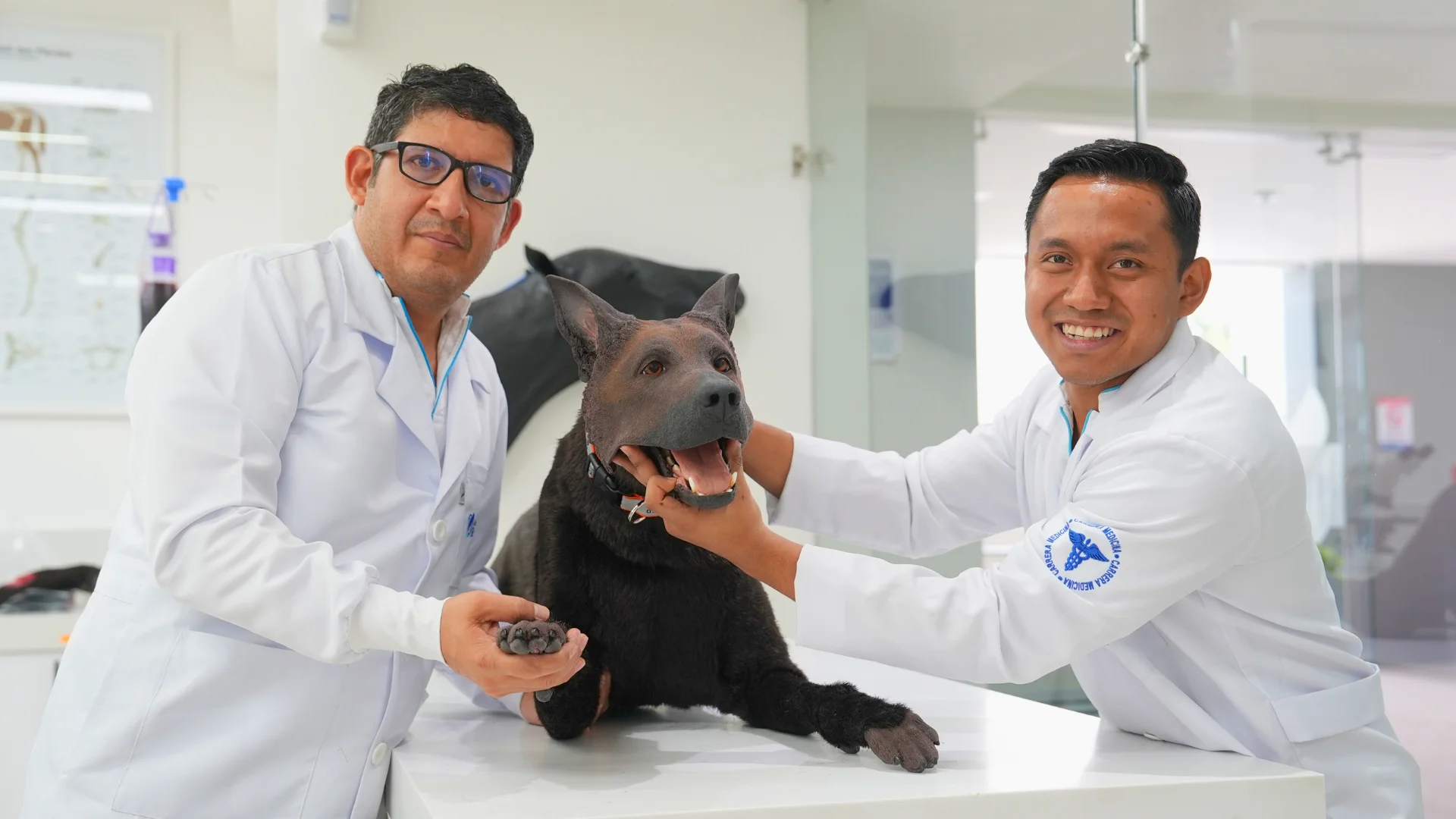
Veterinary Medicine
Undergraduate program · Veterinarian
Modality
In-person
Duration
4.5 years
Campus
La Costa
Request information
An admissions advisor will contact you to answer your questions about Veterinary Medicine.
About the program
Study Veterinary Medicine at ECOTEC
The Veterinary Medicine program prepares well-rounded professionals capable of developing solutions that contribute to the health and well-being of animals, in accordance with the ethical and scientific standards required by public health and by the national and international market.
Degree awarded
Veterinarian
CES Resolution: RPC-SO-10-No.144-2025
Graduate profile
What you will be able to do
When you graduate from Veterinary Medicine, you will have developed these professional competencies.
Carry out processes of analysis and interpretation of information in diverse contexts, promoting the assessment of data to make well-founded judgments, while maintaining a reflective and respectful approach toward different viewpoints for the purpose of contributing effective solutions to complex problems.
Effectively lead work teams, assuming commitments that contribute to the improvement and development of an organization, promoting collaborative leadership to strengthen cohesion and achieve common objectives, with an ethical and responsible attitude in joint decision-making for conflict resolution.
Generate original ideas in diverse contexts, promoting the association of concepts and the identification of relationships among factors to address challenges innovatively, while maintaining an open and flexible attitude toward change with a critical approach to implementing original and creative solutions.
Develop a logical and structured sequence of research processes autonomously and creatively to generate new knowledge and apply and strengthen existing knowledge, collecting and analyzing data clearly and coherently, while maintaining a critical and ethical approach throughout all stages of the research process.
Analyze the structures and functions of the animal organism, as well as their relationship with pathological processes, to identify critical factors in internal medicine and components associated with those pathologies, implementing clinical and surgical protocols grounded in scientific evidence and maintaining a critical and reflective attitude that allows the design of continuous improvement programs to optimize results in veterinary medical practice.
Prepare detailed clinical diagnoses through semiology and the interpretation of diagnostic tests, integrating knowledge of tropical diseases, proposing complex differential diagnoses with a multidisciplinary approach, applying advanced criteria for disease analysis, and promoting informed decision-making based on clinical data and scientific evidence.
Develop strategies for the management and conservation of wildlife and captive fauna, applying ecological knowledge and specialized techniques, designing conservation projects based on scientific results, and promoting a critical and reflective attitude toward the continuous improvement of biodiversity conservation efforts.
Collect animal health data using epidemiological and biostatistical tools, interpret scientific information to propose evidence-based animal health policies and strategies, and foster an ethical and reflective attitude in decision-making to improve veterinary public health and animal welfare.
Career opportunities
Where do Veterinary Medicine professionals work?
A veterinarian cares for the health of animals and, in doing so, for the health of people as well. By studying Veterinary Medicine in Ecuador, you can work in pet clinics, on cattle and poultry farms, in the inspection of foods of animal origin, in animal health control programs, or in wildlife conservation, a field of great importance in such a biodiverse country.
Small Animal Practice
Examines, diagnoses, and treats dogs, cats, and other pets; performs surgeries, vaccinations, and checkups; and advises owners on animal care and welfare.
Livestock Production
Advises cattle, swine, and poultry farms on animal health, reproduction, nutrition, and handling to improve productivity in line with animal welfare standards.
Veterinary Public Health
Takes part in the surveillance and control of zoonoses and communicable diseases, and inspects the safety of meat, milk, and other foods of animal origin.
Wildlife and Conservation
Designs and carries out management plans for wildlife and captive animals at rescue centers, zoos, and conservation projects based on scientific data.
Clinical Diagnosis
Interprets diagnostic tests, develops differential diagnoses, and treats tropical diseases that affect domestic and production animals on Ecuador's coast.
Epidemiology and Research
Gathers animal health data using epidemiological and biostatistical tools, and proposes evidence-based health policies and strategies for public and private institutions.
Study plan
Curriculum and brochure
Download the complete study plan and program information in PDF.
Admissions
Admission requirements
Have these documents ready for your admission process. Your advisor will confirm whether your program requires any additional documents.

ID document
Color copy of your national ID card, or passport if you are an international student.

Academic record
Copy of your high school report card or academic record.

Current photo
Recent color digital photo with a light background.
Where to study
Campuses where Veterinary Medicine is offered
Why ECOTEC
Why study Veterinary Medicine at ECOTEC?
Degree recognized in Spain and the U.S.
Your undergraduate degree is recognized in Spain and the United States (conditions apply depending on the program).




International certifications
Complement your degree with certifications from Meta, Google, Microsoft, and IBM.


Recognized quality
ECOTEC is part of the QS World University Rankings and the Times Higher Education Latin America Rankings.



Three campuses
Study in Samborondón, Guayaquil, or La Costa, with modern classrooms, laboratories, and green areas.
Keep exploring
Other programs in the School of Engineering, Architecture, and Natural Sciences
Compare study plans and find the program that suits you best.

Agronomy

Architecture

Civil Engineering
Environmental Engineering
Industrial Engineering

Intelligent Systems Engineering
FAQ
Most frequently asked questions about Veterinary Medicine
Have another question? An admissions advisor will answer with no obligation.
What does a veterinarian do besides treating pets?
They work in food production, advising cattle, swine, and poultry farms; in public health, controlling diseases that pass from animals to people; in the inspection of foods of animal origin; and in wildlife conservation. Those who study Veterinary Medicine in Ecuador find job opportunities both in the city and in the agricultural sector.
How long is the Veterinary Medicine program at ECOTEC?
The Veterinary Medicine program at ECOTEC University lasts 4.5 years and is taught in person. The curriculum is organized by semesters, and you can review it in full in the study plan available on this page.
What degree will I earn by studying Veterinary Medicine?
When you graduate, you earn the professional degree of Veterinarian. The program is approved by the Council of Higher Education (CES) under resolution RPC-SO-10-No.144-2025, and your degree is registered with SENESCYT, giving it official validity in Ecuador.
Which campus can I study Veterinary Medicine at?
Veterinary Medicine is offered at the La Costa Campus (Vía a la Costa, km 16.5). That is where you will attend classes, do your practical training, and receive admissions support.
What skills do I need to study Veterinary Medicine?
A good foundation in biology and chemistry helps, along with an enjoyment of fieldwork and the patience to handle animals of different sizes and temperaments. You also need composure for clinical and surgical procedures, keen observation to recognize symptoms in patients who cannot say what hurts, and the ability to explain diagnoses and treatments to their owners.
What are the requirements to study Veterinary Medicine at ECOTEC?
To begin your admission to Veterinary Medicine, you need your ID document (Ecuadorian ID card or passport), your high school academic record or report card, and a recent photograph. An admissions advisor will confirm whether any additional documents are needed and will guide you throughout the process.
What is the difference between Veterinary Medicine and Animal Science?
Veterinary Medicine focuses on animal health: prevention, diagnosis, treatment, and surgery, as well as public health. Animal Science focuses on production, that is, on the feeding, genetics, and handling of animals to make a livestock operation more efficient. Veterinarians are also involved in production, but from the standpoint of animal health and welfare.
Admissions open
Start your Veterinary Medicine degree today
An advisor will guide you through the entire admission, scholarship, and cost process.