




Criminalistics
Undergraduate program · Bachelor’s Degree in Criminalistics
Modality
Hybrid
Duration
4 years
Campus
Samborondón, La Costa
Request information
An admissions advisor will contact you to answer your questions about Criminalistics.
About the program
Study Criminalistics at ECOTEC
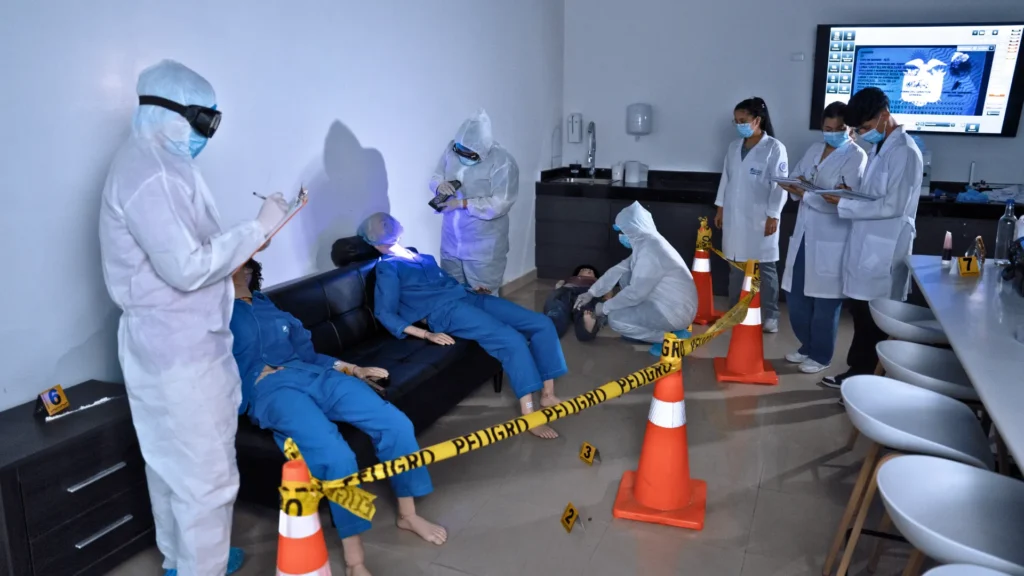
The Criminalistics program prepares well-rounded professionals capable of investigating, analyzing, and verifying criminal acts through scientific and technical methods. The program prepares experts in criminalistics with strong command of investigative tools, the use of information technologies, proper handling of evidence, and an ethical, professional, and responsible approach in national and international contexts.
Degree awarded
Bachelor’s Degree in Criminalistics
CES Resolution: RPC-SO-07-No.103-2025
Graduate profile
What you will be able to do
When you graduate from Criminalistics, you will have developed these professional competencies.
Carry out processes of analysis and interpretation of information in diverse contexts, promoting the assessment of data to issue well-founded judgments, maintaining a reflective and respectful approach toward different positions in order to provide effective solutions to complex problems.
Effectively lead work teams, taking on commitments that contribute to the improvement and development of an organization, promoting collaborative leadership to strengthen cohesion and the achievement of common goals, with an ethical and responsible attitude in joint decision-making for conflict resolution.
Generate original ideas in diverse contexts, promoting the association of concepts and the identification of relationships between factors to address challenges in an innovative way, maintaining an open and flexible attitude toward change with a critical approach in the implementation of original and creative solutions.
Develop a logical and structured sequence of research processes autonomously and creatively, for the generation of new knowledge and the application and strengthening of existing knowledge, collecting and analyzing data clearly and coherently, maintaining a critical and ethical approach at every stage of the research process.
Rigorously apply the scientific method in criminal investigation through systematic and validated procedures for processing the crime scene and analyzing evidence, both physical and digital, ensuring the objectivity and reliability of the results obtained, while always maintaining a commitment to truth and professional ethics.
Analyze specialized techniques for the matching and comparison of undisputed and questioned items, based on the fundamental principles of criminalistics related to detailed observation and identification, to establish well-founded conclusions that answer the expert questions raised by the courts of justice, acting with thoroughness, objectivity and a commitment to scientific rigor.
Identify safety standards and standardized protocols for action in forensic laboratories, enabling the use of good practices in the handling of evidence, ensuring the scientific validity of forensic analyses, and demonstrating methodological rigor and commitment to good professional practices.
Prepare technically sound expert reports to communicate clearly and precisely the results of forensic scientific analyses before judicial and administrative bodies, recognizing the role of the expert witness and demonstrating objectivity and professional ethics in the argumentation of conclusions that contribute to the administration of justice.
Career opportunities
Where do Criminalistics professionals work?
A criminalist applies the scientific method to investigate crimes: they process the scene, collect and analyze physical and digital evidence, and explain their conclusions to prosecutors and judges. Studying Criminalistics in Ecuador prepares you to support criminal investigations and forensic expert work with technical rigor, respect for the chain of custody, and a strong ethical commitment to the truth.
Crime scene investigation
You inspect the scene, document it with photographs and diagrams, and collect evidence following protocols so it retains its value as proof.
Forensic expert testimony
You perform technical analyses requested within a legal proceeding and prepare clear expert reports, which you then present and defend before prosecutors, judges, and courts when called upon.
Forensic laboratory
You support the analysis of evidence in the laboratory, applying biosafety standards and standardized protocols that ensure the scientific validity of each result.
Identification and comparison
You compare fingerprints, documents, signatures, or other questioned and known samples to establish matches or differences that answer the questions posed by the authorities.
Digital evidence
You take part in collecting and analyzing information from electronic devices, safeguarding data integrity and its chain of custody throughout the investigation.
Security and advisory services
You advise lawyers, insurers, or companies on the technical review of cases, fraud investigations, and the assessment of evidence submitted in legal proceedings.
Study plan
Curriculum and brochure
Download the complete study plan and program information in PDF.
Admissions
Admission requirements
Have these documents ready for your admission process. Your advisor will confirm whether your program requires any additional documents.

ID document
Color copy of your national ID card, or passport if you are an international student.

Academic record
Copy of your high school report card or academic record.

Current photo
Recent color digital photo with a light background.
Where to study
Campuses where Criminalistics is offered
Why ECOTEC
Why study Criminalistics at ECOTEC?

Degree recognized in Spain and the U.S.
Your undergraduate degree is recognized in Spain and the United States (conditions apply depending on the program).




International certifications
Complement your degree with certifications from Meta, Google, Microsoft, and IBM.


Recognized quality
ECOTEC is part of the QS World University Rankings and the Times Higher Education Latin America Rankings.



Three campuses
Study in Samborondón, Guayaquil, or La Costa, with modern classrooms, laboratories, and green areas.
Keep exploring
Other programs in the School of Law and Governance
Compare study plans and find the program that suits you best.

FAQ
Most frequently asked questions about Criminalistics
Have another question? An admissions advisor will answer with no obligation.
What does a criminalist do?
They investigate how a crime occurred based on the evidence. They process the scene, collect and preserve evidence, analyze it or coordinate its laboratory analysis, and write expert reports with their conclusions. Their work provides technical support for the Prosecutor's Office's investigations and for judges' decisions, so it demands objectivity and precision.
How long is the Criminalistics program at ECOTEC?
The Criminalistics program at ECOTEC University takes 4 years, in a hybrid format. The curriculum is organized by semesters, and you can review it in full in the curriculum map on this page.
What degree will I earn if I study Criminalistics?
When you graduate, you earn the degree of Licenciado/a en Criminalística (Bachelor's degree in Criminalistics). The program is approved by the Council for Higher Education (CES) under resolution RPC-SO-07-No.103-2025, and your degree is registered with SENESCYT, so it is officially valid in Ecuador.
At which campus can I study Criminalistics?
You can study Criminalistics at the Samborondón campus (Vía Samborondón, Km 13.5) and the La Costa campus (Vía a la Costa, Km 16.5). Choose the campus closest to you: the curriculum is the same at each one.
What is the difference between Criminalistics and Criminology?
Criminalistics answers questions about a specific event: what happened, how, and who was involved, using scientific methods applied to the evidence. Criminology studies crime as a social and human phenomenon: its causes, who commits crimes, and how to prevent them. If you are interested in technical work with evidence and expert analysis, the Criminalistics program in Ecuador is the right choice.
What are the requirements to study Criminalistics at ECOTEC?
To begin your admission to Criminalistics, you need your identity document (national ID card or passport), your high school academic record or report card, and a recent photograph. An admissions advisor will confirm whether any additional documents are needed and will guide you through the entire process.
What skills do I need to study Criminalistics?
You need strong observation skills, patience with details, and an interest in science, because the program uses chemistry, biology, physics, and computer tools. Objectivity, clear writing for your reports, and composure when working at difficult scenes are also key. Ethics matter as much as technique: your conclusions can influence a court case.
Admissions open
Start your Criminalistics degree today
An advisor will guide you through the entire admission process, including scholarships and tuition.